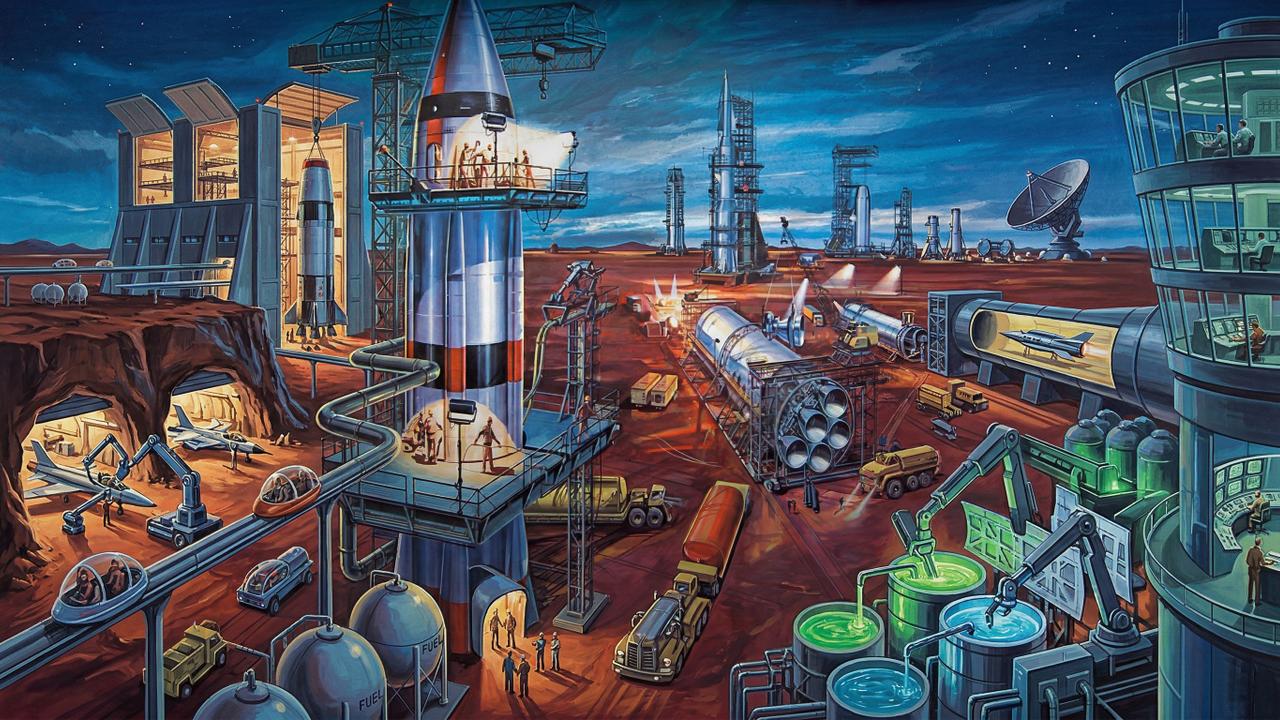

Join us for an evening discussing the future of the space industry.
5:30 Doors Open/Social Time
6:00 Welcome
6:05 Lightning Talks (Moderator: Christian Keil, VP @ Astranis)
7:00 Break
7:30 Panel + Q & A, (Moderator: Alder Riley, Founder @ Small Steps & Giant Leaps)
8:30 Social Time until end (9-9:30)
Thank you to the sponsors & partners of this event including:

CEO, Astro Mechanica
Ian Brooke is the founder and CEO of Astro Mechanica, a San Francisco-based aerospace startup backed by Y Combinator (W24) and investors including United Airlines Ventures, pioneering the turboelectric adaptive engine—a revolutionary hybrid-electric jet propulsion system that maintains peak efficiency across all speeds from takeoff to Mach 3+, enabling sustainable supersonic commercial flight, long-range cargo, national defense applications, and even cost-effective orbital launches via air-breathing stages. A lifelong pilot who began flying at age 16 and inspired by fighter jets like the F-15, Brooke—a University of Colorado Boulder physics graduate and serial entrepreneur with a prior successful venture—launched Astro Mechanica in 2021 to disrupt a stagnant industry, rapidly prototyping engines in months using off-the-shelf components and raising significant funding (including $27M+ rounds) to challenge incumbents like Boeing and GE. Passionately advocating for a new "Turboelectric Age" of abundant, point-to-point global mobility—shrinking transcontinental trips to hours at economy fares while slashing fuel use—he drives milestones like supersonic demonstrations targeted for 2025 and vertical integration toward building the next-generation aerospace titan.

Astronaut, NASA (retired)
panelistCatherine "Cady" Coleman is a retired NASA astronaut, chemist, and former U.S. Air Force colonel who logged over 180 days in space across three missions. Selected by NASA in 1992, she flew as a mission specialist on Space Shuttle Columbia missions STS-73 (1995), focused on microgravity experiments, and STS-93 (1999), which deployed the Chandra X-Ray Observatory. Her longest assignment was a six-month stay on the International Space Station as part of Expeditions 26/27 (2010–2011), where she served as lead robotics and science officer. Post-NASA, Coleman has become a speaker on leadership, inclusion in STEM, and innovation, while also known for her flute performances in space and consulting on films like Gravity.

CEO, Astranis
John Gedmark is an American aerospace engineer and entrepreneur best known as the co-founder and CEO of Astranis Space Technologies, a San Francisco-based company he launched in 2015 to build small, cost-effective geostationary satellites using software-defined radios to provide dedicated broadband connectivity worldwide. Under his leadership, Astranis has raised hundreds of millions in funding, launched its first commercial satellite Arcturus in 2023, secured contracts with customers in Alaska, the Philippines, Mexico, Thailand, Taiwan, and the U.S. government—including military applications—and scaled production toward dozens of satellites annually. Previously, Gedmark co-founded and led the Commercial Spaceflight Federation, advocating for commercial crew policies, and served as Director of Rocket Flight Operations for the X Prize Foundation. He holds a BS in Aerospace Engineering from Purdue University and an MS from Stanford University, focusing on rocket propulsion.

Former Chief Scientist, NASA (retired)
panelistDr. James "Jim" L. Green is an American space physicist and retired NASA leader renowned for his 42-year career at the agency, culminating as Chief Scientist (2018–2022) and the longest-serving Director of the Planetary Science Division (2006–2018). A University of Iowa Ph.D. (1979) recipient, he pioneered NASA's early internet-like data networks, served as co-investigator on missions like IMAGE, and oversaw landmark explorations including New Horizons' Pluto flyby, Juno to Jupiter, Curiosity and Perseverance on Mars, and evidence of ancient water flows on the Red Planet. Post-retirement in 2022, Green has advised on health innovations drawing from space science, advocated for planetary protection, and continued public outreach through podcasts and talks, earning NASA's Distinguished Service Medal and having asteroid 25913 Jamesgreen named in his honor.

CoFounder, Zipline
Ryan Oksenhorn is an American software engineer and entrepreneur best known as a co-founder of Zipline, the pioneering autonomous drone delivery company he helped launch in 2014 alongside Keller Rinaudo Cliffton, Keenan Wyrobek, and William Hetzler—pivoting from their prior robotics startup Romotive. A Carnegie Mellon University computer science graduate (BS, 2012), Oksenhorn has led Zipline's software development, including cloud systems for geospatial routing, weather integration, inventory, and airspace management, as well as flight software for perception, navigation, and controls. Under his technical contributions, Zipline has scaled to over one million deliveries of medical supplies, vaccines, and consumer goods worldwide, expanded U.S. operations with partners like Walmart, and achieved a multi-billion-dollar valuation while advancing instant, emissions-free logistics.

CEO, Array Labs
Andrew Peterson is an American aerospace engineer and entrepreneur best known as the co-founder and CEO of Array Labs, a Palo Alto-based startup launched in 2021 that develops distributed radar satellite constellations using formation-flying clusters of small satellites to generate high-resolution, real-time 3D imagery of Earth—achieving over 60x better quality than traditional methods for applications in defense, autonomy, climate monitoring, agriculture, and insurance. A Y Combinator alumnus with prior roles leading remote sensing projects at Moog Space and Defense, General Atomics (on Video SAR algorithms), and contributions to the Vera Rubin Observatory, Peterson holds a BS in Aerospace Engineering from Cal Poly Pomona and an MS from San Diego State University. Under his leadership, Array Labs has launched demonstration satellites, secured Air Force contracts, partnered with entities like Raytheon and John Deere, and advanced toward operational clusters capable of sub-20cm resolution spotlight imaging.

CoFounder, Turion Space
Ryan Westerdahl is an American aerospace engineer and entrepreneur best known as the co-founder and CEO of Turion Space, an Irvine, California-based startup launched in 2020 (YC S21) that builds autonomous "Droid" spacecraft for space domain awareness, orbital debris removal, satellite servicing, and long-term ambitions in asteroid mining. A former SpaceX propulsion dynamicist (2013–2021) with 8.5 years contributing to vehicle analysis, anomaly resolution, and certification, Westerdahl has led Turion to launch its first Droid.001 satellite in 2023, secure U.S. Space Force contracts (including $1.9M for debris-capture tech), raise over $26M in funding, grow to 70+ employees, and win selection for major government programs—positioning the company as a key player in sustainable space infrastructure and national security.

Research Scientist, NASA Ames
panelistDr. Mary Beth Wilhelm is a planetary scientist at NASA Ames Research Center, where she works on missions related to Mars exploration, including analyzing data from rovers like Curiosity and Perseverance.

Founder, Small Steps & Giant Leaps
moderatorAlder Riley is the Founder of Small Steps & Giant Leaps, a company involved in events related to aerospace innovation. They have moderated panels at aerospace-focused gatherings, such as Giant Step VC x SSGL: Aerospace Night, demonstrating their expertise in facilitating discussions on deep tech topics. Riley's role highlights their commitment to advancing conversations in the aerospace sector.

CEO, Icarus
Henry Kwan is the CEO of Icarus, a company focused on advancing space technology through innovative aerospace solutions. He leads strategic initiatives, including product development and team management, to drive the company's growth in the space sector. With a background in aerospace engineering from his roles at SpaceX and NASA, Kwan has achieved notable successes such as leading successful satellite launches and securing significant funding. His expertise includes space systems, hardware engineering, and orbital mechanics.

VP, Astranis
moderatorChristian Keil is a co-founder of Astranis, a company focused on building affordable and advanced satellites for global connectivity. He has expertise in hardware engineering and has played a key role in developing innovative space technology solutions. As VP, he currently leads hardware development efforts at Astranis.